🧠 The AI-Powered PM
How AI is Radically Rewiring Product Management

“AI won’t take your job. But the PM who knows how to leverage AI just might.”
Over the past few months, I've talked to PMs across companies like Notion, Ramp, OpenAI, and Glean—and one theme keeps coming up: AI is not just a new tool in the toolbox. It’s changing the toolbox entirely.
Whether you're building internal tools, shipping customer-facing features, or leading platform strategy, the nature of product management is shifting. And if you're not adapting, you're falling behind.
In this post, I’ll break down exactly how AI is transforming the PM craft—across three key vectors:
How we work
What we work on
Where we work
Along the way, I’ll share tactical frameworks, real-world tools, and a starter stack to help you stay ahead.
1. How We Work → AI as the New Execution Layer
“AI is compressing the time between idea and execution.”
— Lenny’s Podcast
Let’s be honest: most PMs aren’t using AI to its full potential yet. But the ones who are—are moving fast.
We’re seeing a radical shift from manual, cross-functional workflows to AI-augmented execution stacks. Think of it like this:

Tools worth trying:
Cursor – AI-native IDE with context-aware code generation
v0.dev – Frontend UI from natural language prompts
Bolt – One-click prototypes from PRDs
Glean – Enterprise search with LLM summarization
GitHub Copilot – Boilerplate killer + telemetry assistant
But with speed comes complexity. If PRDs can be created in minutes, who reviews them? If prototypes are ready tomorrow, are your stakeholders prepared? This is the Jevon’s Paradox of AI: more content → more coordination.
2. What We Work On → Building AI-Native Products
“Everyone wants to add an AI feature. Few are building AI-native products.”
— Sara Guo on Lenny’s Podcast
There’s a big difference between bolting on a chatbot and rethinking your product around AI capabilities. AI-native product management requires a new mindset—and a new development lifecycle.
🔁 New Workflows for PMs
✏️ Eval-Driven Development
In traditional software, we write unit tests. In AI, we write evals—structured inputs that test an LLM’s ability to:
Respond accurately
Maintain tone
Avoid hallucinations
Handle edge cases
These evals become part of the product. If you’re not defining them, your model is shipping blind.
⚖️ Model Strategy = Product Strategy
Model choice is no longer a backend detail—it shapes the UX.
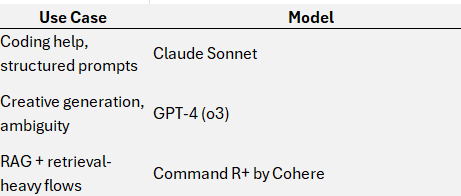
Great PMs are building LLM selection matrices—think vendor scorecards, but for models.
🎨 UX Beyond the Chatbox
We're leaving behind the era of chat UIs. Agentic UX is rising. That means:
Users issue high-level intents
Agents act autonomously
PMs define handoff moments, escalation paths, and debugging flows
Example: Instead of "Ask our chatbot for help," imagine "Upload your dataset and let the agent auto-clean, tag, and visualize it."
🔧 Designing for AI-Native Experiences
Slack AI summarizing threads
Notion AI writing your next doc
Linear AI auto-prioritizing tickets
The future isn’t point-and-click—it’s intent-and-go.
3. Where We Work → Async, Agentic, Decentralized
“It used to be enough to be the most organized PM. Now, you need to be the most leveraged.”
— Paraphrasing Shreyas Doshi
AI is making PM work more distributed—and more autonomous.
🤖 From Team-First to Agent-Augmented
AI agents now complete tasks, not just support them
Teams operate more asynchronously, with agents acting on behalf of users
New questions arise:
Who’s responsible for the agent’s behavior?
How do you QA its actions?
When does a human step in?
📉 Beware the Content Abundance Trap
AI generates a lot. More PRDs. More designs. More copy variants.
The PM skill of the future? Curating signal from noise.
The best PMs will shift from doing → orchestrating.
🧰 Bonus: The AI-Native PM Toolkit
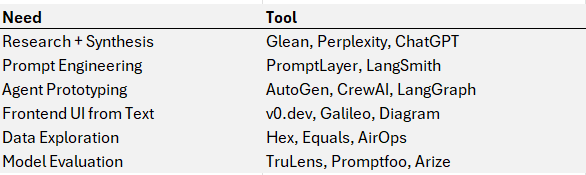
Want a deeper breakdown of this stack? Reply or comment—I’ll share a full teardown in a future post.
🧠 Final Thoughts
AI is transforming PM from the ground up. This isn’t just a tooling change—it’s a shift in the fabric of product work.
PMs of the future will:
Orchestrate AI agents and human contributors
Define evaluation metrics, model ops, and trust boundaries
Prioritize amidst infinite content
Deliver outcomes, not just outputs
“The most successful PMs won’t be the ones who write the best specs. They’ll be the ones who manage the best systems of humans and machines.”
You don’t need to master everything today. But you do need to start. And the sooner you do, the further ahead you’ll be.
References:


🛠 Coming next:
A teardown of the top AI tools for PMs
A framework for evaluating LLMs in product workflows
Real stories from PMs building AI-native features
Subscribe so you don’t miss it →